Gaming Composition N.B for Boys Keywords and Amazon KDP Success
The landscape of self-publishing on Amazon's Kindle Direct Publishing (KDP) platform is both vast and competitive. Authors and publishers often find that a well-designed book, while essential, is insufficient to guarantee visibility or sales. This has led to a growing focus on keyword research as a foundational strategy for market entry. Among various niches, the concept of "Gaming Composition N.B for Boys Keywords" represents a specific, data-driven approach to targeting a segment of the journal and notebook market catering to young male gamers.
Understanding Gaming Composition N.B for Boys Keywords
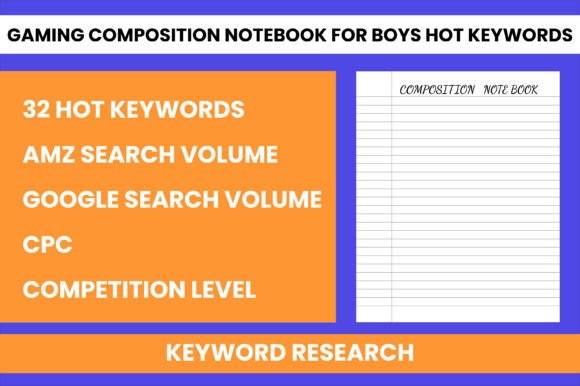
Gaming Composition N.B for Boys Keywords refers to a curated set of search terms specifically analyzed for their potential profitability in the Amazon KDP marketplace. These keywords are designed around products like notebooks or composition books that feature gaming-themed designs, content, or organization systems intended for boys. The keyword analysis typically involves metrics such as Amazon search volume, Google search volume, Cost Per Click (CPC), and competition level. This data compilation aims to identify terms where buyer interest is present but publisher saturation is low, creating an opportunity for a new book to rank prominently in Amazon search results.
In practical terms, these keywords are not just random phrases; they are the verbal bridges that connect a potential customer's search to your specific product. For example, a term like "gaming journal for teen boys" or "Minecraft notebook for school" encapsulates the product's theme, audience, and use-case. Utilizing these keywords effectively in your book's title, subtitle, and backend KDP keywords is a critical step in ensuring the product is discovered by the right audience.
Reasons for Interest and Core Benefits
Individuals exploring Gaming Composition N.B for Boys Keywords are usually KDP publishers or authors who have experienced the challenge of launching books without significant traction. The primary reason for interest is the pursuit of a methodological advantage. Instead of relying on intuition or generic design, this approach offers a blueprint based on market data.
The core benefit is targeted visibility. High-quality keyword data can theoretically reduce the time and financial investment wasted on products that have no clear path to the first page of Amazon search. By focusing on niches with validated demand and lower competition, publishers increase the probability of their book appearing when a relevant search is performed. This enhanced visibility directly correlates with increased chances of sales conversion. Furthermore, such analysis can reveal adjacent niches or product variations, aiding in the planning of a series or a broader catalog.
Tradeoffs and Important Considerations
While the promise of data-driven publishing is compelling, it is crucial to approach it with a balanced perspective. A keyword file, such as one listing 32 profitable keywords with associated metrics, is a tool, not a guarantee. Success still depends heavily on execution.
First, the data itself must be current and accurate. Amazon's search algorithm and consumer trends evolve, so historical or stale data may lead to misdirected efforts. Publishers should consider how recently the data was collected. Second, low competition is a relative metric. A niche with truly zero competition might also indicate very low demand. The ideal target is a balance of decent search volume and manageable competition.
Another significant tradeoff is the potential for market saturation. If a keyword list becomes widely used, the "low competition" niche it identifies can quickly become high competition, diminishing its value. Additionally, focusing solely on keyword optimization might lead to undervaluing other critical success factors. A book must still meet quality standards in design, content, and presentation. A poorly executed notebook, even if perfectly keyword-optimized, will suffer from poor reviews and low conversion rates.
Situations Where This Approach Is a Strong Fit
The use of Gaming Composition N.B for Boys Keywords analysis is particularly well-suited for certain scenarios. It is a strong fit for new publishers entering the KDP journal and notebook space who lack firsthand market experience. The data provides a guided starting point, reducing initial uncertainty.
It is also highly valuable for publishers who have a catalog of books but are struggling with low sales across their titles. This analysis can serve as a diagnostic tool, helping to pivot their efforts toward more promising niches based on tangible metrics rather than guesswork. Furthermore, for publishers with strong design capabilities but limited marketing insight, pairing good design with strong keyword research creates a more complete product launch strategy.
When Alternatives Might Be Worth Considering
Despite its utility, this keyword-focused approach may not be the optimal path in all circumstances. Publishers who already have a deep, proven understanding of the gaming niche or a strong, established brand might find that their internal research and audience knowledge yield better results. For them, purchasing generic keyword data might be an unnecessary expense.
Alternatives include investing in broader market research tools that offer ongoing data updates and trend analysis, rather than a static list. Additionally, a publisher whose primary goal is artistic expression or filling a very specific, personal niche—even if it's not highly searched—might prioritize passion over pure profitability metrics. In such cases, keyword optimization would be a secondary concern. Another alternative is to focus efforts on building an audience outside of Amazon (through social media or a website) and driving direct traffic to the KDP listing, thereby reducing dependency on Amazon's internal search algorithm.
Practical Decision-Making Insights
To determine if focusing on Gaming Composition N.B for Boys Keywords aligns with your goals, conduct a self-assessment. Begin by evaluating your past performance. Have your well-designed books failed to sell? If yes, the lack of keyword optimization might be a key gap. Next, consider your resources. Are you more adept at design than data analysis? If so, leveraging pre-analyzed keywords can complement your skills.
When evaluating a specific keyword data file, scrutinize its provenance. Who compiled it? What methods were used? Are the metrics explained? A file offering only a list without methodological context carries more risk. Also, plan for integration. How will you implement these keywords into your book's metadata? Simply having the list is useless without proper application on the KDP platform.
Ultimately, the decision hinges on your model. If you view your KDP publishing as a business requiring systematic, scalable processes, then data-driven keyword research is likely a necessary component. If you approach it as a casual or purely creative endeavor, its importance diminishes. The most successful publishers often blend both: they use data to find opportunities and then apply creative excellence to seize them.
In the competitive ecosystem of Amazon KDP, visibility is the first battle. Gaming Composition N.B for Boys Keywords represents a tactical tool for winning that initial skirmish. By understanding its function, benefits, and limitations, publishers can make an informed choice about whether this data-driven path supports their journey from publication to profitable sale.